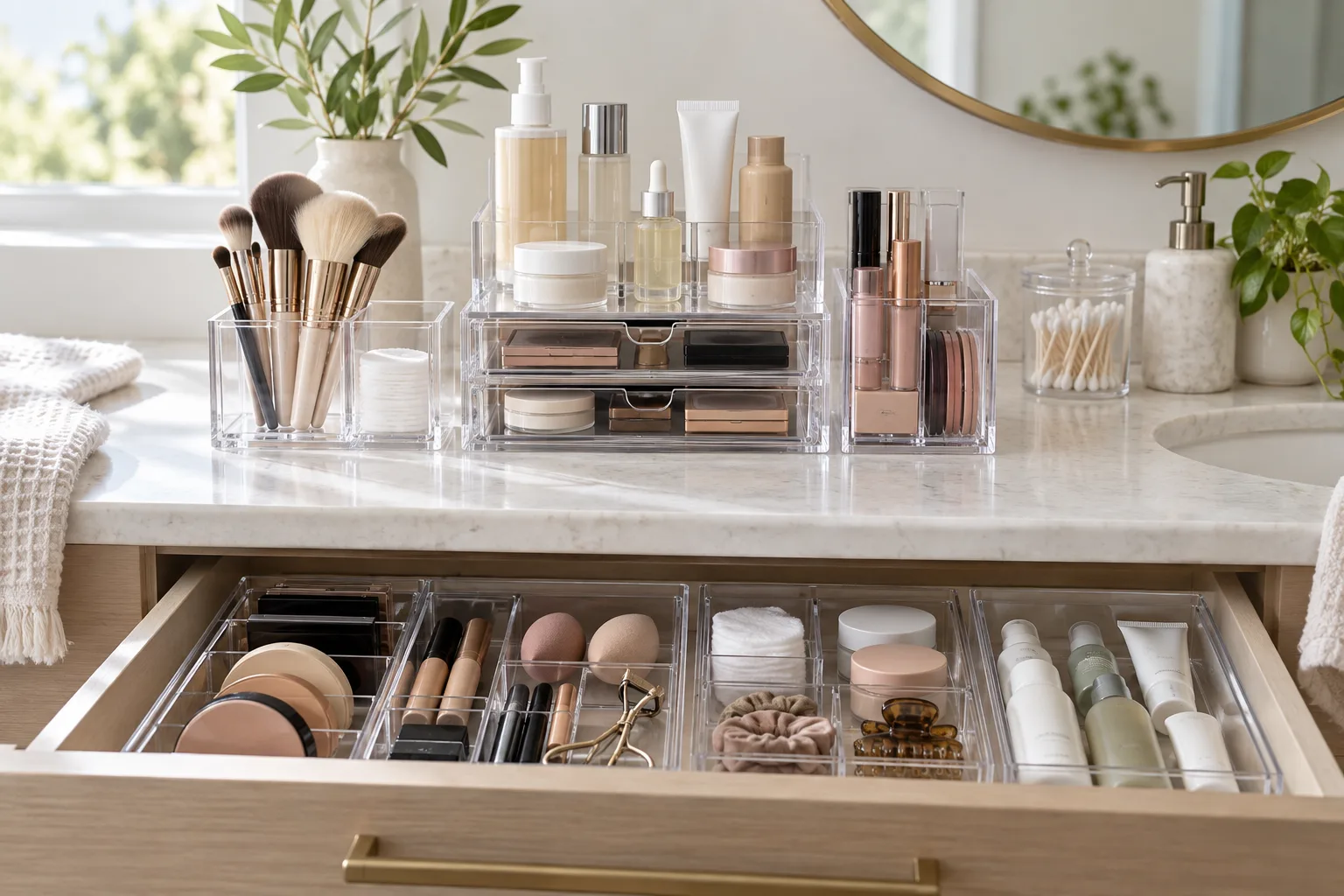
Makeup organizers are often sold as a visual solution: clear drawers, neat brush cups, and a countertop that looks calm in a product photograph. The useful standard is more demanding. An organizer should make daily items easy to reach, keep products upright when necessary, fit the vanity or drawer, and remain cleanable as powders, creams, and hair collect around it. More compartments do not automatically create a better system.
Start with the routine you already perform. The U.S. Food and Drug Administration's cosmetics guidance is a useful reference for general cosmetic information and labeling questions, while product-specific storage and expiration directions belong to the manufacturer. Storage can improve access and cleanliness, but it does not replace following the directions for each cosmetic.
Inventory the routine before buying containers
Empty one drawer or countertop area and group products by the order in which you use them. Keep daily base products together, separate color products that need a quick visual scan, and isolate tools such as brushes, sponges, tweezers, or lash curlers. Put backups and occasional products elsewhere. This inventory usually reveals that the problem is not a shortage of compartments; it is that high-frequency items are mixed with products that rarely leave the drawer.
Measure the products that determine the system: the tallest bottle, widest palette, longest brush, and largest compact. Count how many items need to remain upright. A shallow drawer organizer can be excellent for palettes and disappointing for pumps. A tall acrylic tower can hold bottles and make a small counter feel crowded. Design around the limiting items first, then fill the remaining space.
Choose countertop, drawer, or modular storage
Countertop organizers provide visibility and speed. They suit products used every morning and work well when the vanity has enough depth for the organizer plus elbow room. Drawers reduce visual clutter and protect products from some dust, though they require labels, dividers, or a consistent layout to prevent forgotten items. A modular system lets you combine shallow trays, brush cups, and narrow bins as the routine changes.
Do not use a tower simply because it holds the most. A tall unit can be unstable when a drawer is pulled quickly, and it may block a mirror or light. Check the footprint, center of gravity, drawer stop, and whether the unit can be anchored or placed safely. If you share the counter, a smaller system that preserves clear space may be more successful than a large display that makes the whole surface harder to use.
Compare materials by cleaning and contact
Clear acrylic makes colors easy to see and can keep small products visible. It also shows fingerprints, powder, and scratches. Glass can feel substantial and clean well, but it adds weight and can break. Metal may provide a durable frame and a different look, while fabric or wood organizers can soften a room and require more attention to stains or moisture. The best material is the one that matches the mess and cleaning method of the location.
Look at corners, seams, drawer edges, and ventilation. A tight compartment can trap powder. A textured liner can hold products in place and collect residue. If a part is difficult to remove, cleaning becomes less likely. Choose surfaces that can be wiped with the method allowed by the manufacturer, and keep liquids from pooling beneath containers. An organizer should make hygiene easier, not create a hidden layer of grime.
Put access before visual symmetry
Organize by frequency, not by color alone. Daily products belong at hand height or in the first drawer. Occasional products can sit higher or farther back. Keep brushes where the handles can dry and remain protected from contact with used products. Heavy palettes should not be stacked so high that the pile falls when you remove the bottom one. Leave a little space for the products you will add next month.
The fastest system is usually the one with the fewest motions. If a drawer must be opened, a tray removed, and a stack unwrapped before you can reach a product, it will migrate to the countertop. Use open sections for daily items and covered or less accessible storage for backups. A little asymmetry is preferable to a perfectly arranged system that slows the routine.
Account for the bathroom environment
Bathrooms can combine humidity, splashes, heat, and limited ventilation. Keep products away from direct water and avoid storing them where a shower plume reaches the counter. Wipe the surface beneath organizers regularly, especially around pumps and jars. If the room is damp, a material that tolerates wiping and dries quickly may be more useful than a porous decorative option.
The mirror and lighting also affect the choice. Clear organizers can be helpful under uneven light because they show product colors, though glare may make labels harder to read. A matte or opaque bin can calm the visual field and reduce reflections. Measure the space with the lights on and the drawers open. A system that looks fine in daylight may block the task lighting you need at night.
Build in a reset and replacement plan
Every organizer needs a reset. Once a week, return daily items to their assigned sections and remove empty packaging. Wipe the areas where powders collect and clean tools according to their instructions. Every few months, review products that have changed texture, smell, or performance and follow the maker's guidance for disposal. Storage is not a freshness guarantee; it only makes the condition of the collection easier to see.
Choose organizers that can be rearranged. Removable dividers, stackable trays, and separate brush cups allow the system to grow without replacing everything. Avoid a deep compartment that only works for one exact product size. If you move, change routines, or switch packaging, a modular unit can continue to serve the space. Flexibility is part of value.
The makeup organizer buying checklist
Before ordering, record the counter or drawer dimensions, tallest and widest products, items that need to stay upright, daily-use count, cleaning method, stability, drawer travel, and material. Decide what must be visible and what can be stored away. Check the return terms if the organizer is rigid and the measurements are close. Leave clearance for opening drawers and for wiping the surface around the unit.
The best makeup organizers make the routine shorter and the collection easier to maintain. Choose the storage format from your space, the compartments from your measurements, and the material from your cleaning reality. A calm vanity is useful when it remains accessible after a busy morning, not only when it is photographed immediately after setup.
Common questions
Are clear makeup organizers worth it?
They are useful when visibility is the main problem and you can tolerate fingerprints and powder showing. If the counter is already visually busy, drawers or opaque trays may create a more usable system.
Should brushes be stored in a closed drawer?
They can be, provided they are clean and dry and the compartment protects the bristles from being crushed. A covered cup or dedicated tray can also work. Follow the care directions for the tools and avoid storing damp items.
How many compartments should an organizer have?
Enough to separate the products you use and reach. Excess compartments waste space and encourage categories that are too precise to maintain. Measure first, then choose the simplest layout that supports the routine.