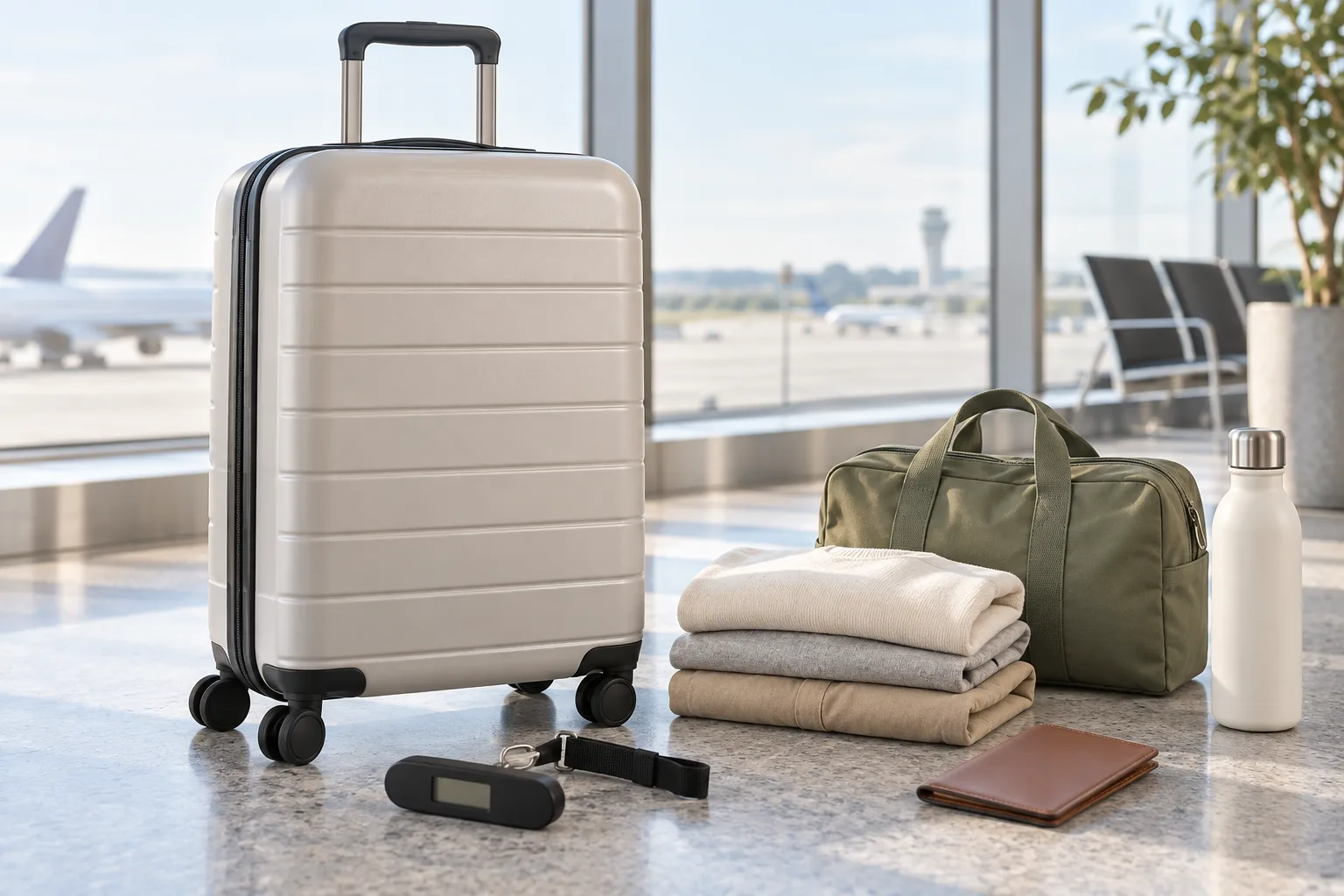
Lightweight luggage sounds like a simple specification. A suitcase that weighs less before packing leaves more of your airline allowance for clothes, shoes, and equipment. The complication is that a lower empty weight can come from thinner panels, smaller wheels, a shorter handle, less interior structure, or a design that is difficult to pack efficiently. The useful question is not simply “What is the lightest suitcase?” It is “Which weight, capacity, and durability trade-off fits this trip?”
This guide gives you a way to compare lightweight luggage without relying on a product photograph or a vague adjective. It covers the empty weight, external dimensions, usable capacity, shell or fabric construction, rolling system, handle, interior layout, and the practical details that matter at the airport. Check the current rules for your airline and destination before purchasing; the TSA What Can I Bring resource is a useful starting point for U.S. screening questions, though airline baggage limits remain carrier-specific.
Start with the trip, not the suitcase category
A short business trip, a multi-city rail journey, and a checked family holiday place different demands on a bag. For a two-night trip, organization and easy access may be more valuable than maximum liters. For a long trip, a light shell can help, but capacity, wheel durability, and compression control may matter more. If the bag will be lifted into overhead storage, handle comfort and balance become central. If it will be checked, corner protection, wheel housing, and a repair plan deserve more attention.
Write down the normal route. Count the number of stairs, train platforms, hotel thresholds, cobbled streets, and transfers. Four smooth spinner wheels are convenient on a terminal floor, while larger wheels with some clearance can be easier on rough pavement. A soft-sided case may fit into a crowded trunk more flexibly, while a hard-sided case can protect a fragile load more consistently. The best construction depends on the surfaces and handling your trip actually includes.
Empty weight is only the first measurement
Compare the listed empty weight in the same size and configuration. A carry-on with an integrated garment panel, expansion zipper, thick lining, and large wheel housings may weigh more than a stripped-down case, but it may also pack more predictably. Check whether the published weight includes the removable accessories, compression board, or detachable battery. Retailer listings can describe similar sizes using different measurement conventions, so record the actual exterior dimensions as well as the kilograms or pounds.
Then examine the ratio between weight and usable space. A very rounded shell may have a generous headline capacity and less useful room near the corners. A narrow interior can make shoes and rigid toiletry cases difficult to place. Look for a flat packing surface, a divided interior, compression straps, and pockets that do not consume the main compartment. Weight savings are meaningful when they leave you with an organized bag rather than a larger volume of loose items.
Check external dimensions and expansion carefully
Airlines and transport operators usually care about the outside dimensions, including wheels and handles. A case that is marketed as a particular cabin size can exceed a carrier's limit when its wheel housings or front pocket are included. Measure the suitcase as it will travel, not only the shell. Expansion is useful for the return journey and can also turn a compliant case into one that is too deep for a specific limit. Treat the expanded position as a separate configuration.
Expansion also changes handling. A deeper case can become top-heavy and harder to steer when the added space is filled. Test whether the zipper opens smoothly and whether the side walls remain stable. If a product description gives several capacity figures, note which one represents the unexpanded interior. A realistic packing plan should fit the normal position; expansion is a reserve, not permission to pack without a limit.
Compare shells, fabrics, and stress points
Hard-sided luggage usually offers a structured cavity and a surface that can be wiped. Polycarbonate, polypropylene, and ABS are described differently across manufacturers, and the material name alone does not reveal the thickness, flexibility, or repairability of a particular case. Inspect the corners, zipper track, wheel mounts, and handle attachment. These areas experience concentrated stress when a case is dragged over a curb or pulled from a baggage belt.
Soft-sided luggage can provide exterior pockets and a little more flexibility in tight spaces. Its fabric, stitching, zipper, frame, and wheel housing should be evaluated together. Check whether the base is reinforced and whether the front pocket is padded or simply adds depth. Water resistance is not the same as waterproofing. If the case will see rain, look for a stated construction and a care method instead of treating a coated fabric as a guarantee.
Wheels and handles determine daily effort
Spinner wheels are easy to turn in a queue, though they can take more abuse when exposed at the corners. Two-wheel designs can roll over uneven surfaces with less wheel hardware, but they ask you to tilt the case and can place more load on your arm. Inspect the wheel diameter, housing, smoothness, and replacement policy. A beautiful lightweight case with small, noisy wheels may be tiring on a long connection.
The telescoping handle should lock at a useful height and resist side-to-side movement. A little designed play is normal; excessive wobble suggests that the handle may feel unstable when the bag is full. Check the grip shape and the distance between the handle rails, especially if you plan to rest a personal item on top. A handle that is light because it is narrow can make a packed suitcase harder to steer.
Build a packing and care routine around the interior
A good interior reduces the temptation to overfill. Compression straps should hold a folded load without cutting into delicate fabric. A zippered divider can separate shoes or laundry, while a simple open cavity may be better for bulky items. Check whether the lining can be removed or wiped, whether the zipper pulls are easy to use, and whether the case opens fully on a hotel bed without spilling everything into the walkway.
Weight savings do not excuse poor care habits. Keep liquids in appropriate containers, distribute heavy items near the wheel end, and avoid placing sharp edges against thin panels. Follow the manufacturer's cleaning instructions. Do not use heat to dry a wet interior unless the guidance allows it. Record the warranty terms, the exclusions for airline handling, and the process for obtaining replacement wheels or handles before a problem appears.
Make the final lightweight luggage comparison
Create a small comparison sheet with empty weight, exterior dimensions, expanded dimensions, usable capacity, material, wheel design, handle height, lock type, interior layout, warranty, repair options, and return period. Add the route you expect to travel. A case that wins on weight but fails on stairs, wheel size, or packing access may create more friction than it removes.
The strongest lightweight luggage choice is a balanced one. It gives you a meaningful weight advantage without making the case fragile, unstable, or difficult to organize. Confirm the current dimensions with the retailer and your carrier, then judge the suitcase after considering the whole journey. Empty weight matters, but a bag earns its place through the way it carries a real load across real surfaces.
Questions shoppers often ask
Is lighter luggage always better?
No. A small weight saving can be worthwhile, but the case still needs wheels, handles, protection, and usable capacity appropriate to the trip. Compare the complete construction rather than the headline number.
Should I choose hard-sided or soft-sided lightweight luggage?
Choose hard-sided luggage for a structured cavity and easy wipe-down surface; choose soft-sided luggage when exterior access and flexible loading matter more. The specific wheel, zipper, frame, and fabric construction decide how either type performs.
Does an expandable suitcase remain carry-on compliant?
Only if its outside dimensions remain within the relevant carrier's limit in the configuration you use. Measure the expanded depth and include wheels and handles. Rules vary, so verify them before travel.