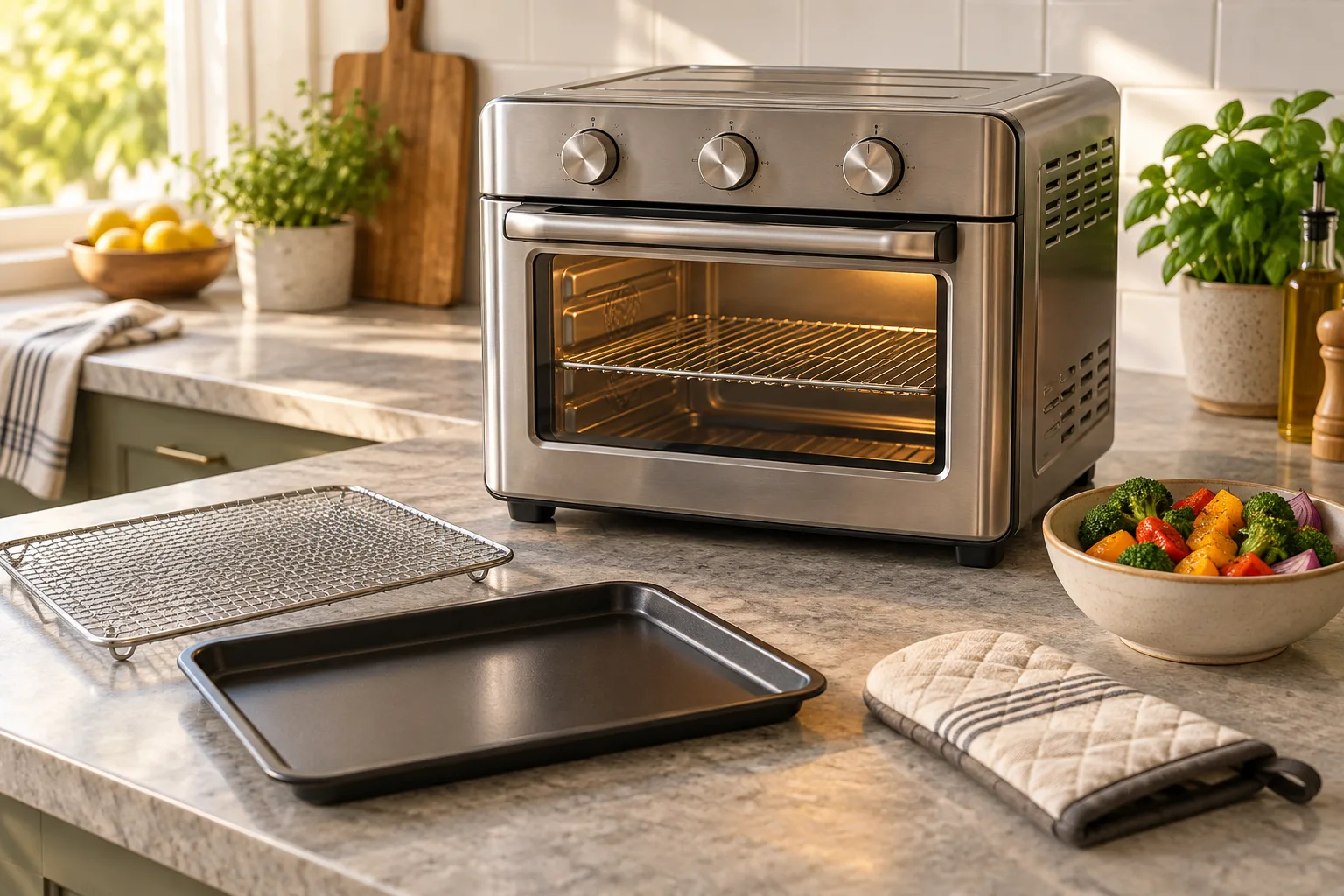
An air fryer oven sits between a basket air fryer and a compact toaster oven. It can appeal to a household that wants crisp food, reheating, roasting, and small-batch baking from one countertop appliance. The larger cavity can also become the problem: it takes more space, may need more clearance, and can be slower to clean than a removable basket. The right choice depends on the cooking jobs you will repeat, not on the number of presets printed on the front.
Before comparing models, measure the counter, the cabinet clearance above it, and the space needed to open the door. Read the manufacturer's safety instructions and keep the appliance away from materials that can be damaged by heat. The U.S. Consumer Product Safety Commission provides general household safety resources; the exact clearance, rack position, and cleaning guidance belong to the appliance's current manual.
Decide which appliance it needs to replace
An air fryer oven is most useful when it solves a specific sequence. You might want to roast vegetables while a main oven is occupied, reheat a slice of pizza without making it soggy, toast bread, or cook a small tray without heating a full-size oven. If you mainly cook one portion of frozen food, a compact basket format may heat faster and take less counter space. If you want trays and multiple levels, the oven format makes more sense.
Write down five meals or tasks you would use it for in an ordinary week. Separate cooking from reheating and baking. A machine may perform well at one and merely advertise the others. Capacity should follow the list. A large cavity that sits empty is wasted counter space, while a tiny cavity that cannot accept the tray you use most often becomes an appliance you work around.
Measure the real countertop footprint
Measure width, depth, and height with the door closed, then measure the clearance needed with the door open. Include the handle, rear vents, side vents, and the distance required to remove a hot tray. A countertop appliance needs a stable surface that can tolerate heat and a location where its controls remain visible. Do not place it under a cabinet if the manual requires open space above it.
The door design affects the room around it. A drop-down door can act as a temporary shelf but needs space in front. A side-hinged door can be easier in a narrow area and may restrict access from one side. Check whether the crumb tray and racks can be removed without hitting the backsplash. A footprint that works on paper can still feel cramped when you are wearing oven mitts and carrying a hot tray.
Compare capacity by food shape, not only liters
Manufacturers may describe a cavity by quarts, liters, tray size, or the number of food items it can hold. Use the measurements of the foods and pans you actually use. Can it hold the baking dish you already own? Can a chicken, loaf, or sheet of vegetables fit without touching the heating elements? Does the rack have two usable positions, or does one position make the food too close to the top element?
Airflow needs room. Overfilling a rack can block circulation and create uneven browning, even if the food technically fits. A shallow layer may crisp more reliably than a packed tray. Multiple racks add capacity but can require rotation. Ask whether the manual provides guidance for rack placement and whether the appliance expects you to turn food halfway through a cycle. Capacity is useful only when it remains usable at the heat setting and arrangement you need.
Understand modes, temperature range, and controls
Presets are shortcuts, not a performance guarantee. Compare the actual modes: air fry, bake, broil, toast, roast, dehydrate, or reheat. Note the temperature range, timer limit, preheat behavior, and whether the fan runs continuously. A mechanical dial can be quick to adjust, while a digital panel can provide more precise settings. Either can work if the controls are readable and responsive when the counter is busy.
Look for instructions about preheating, pan position, and cooking-time adjustments. An air fryer oven may use a fan and a smaller cavity to cook differently from a full-size oven. Recipes written for a basket model may need a different arrangement on a rack. Favor a manual that explains the variables rather than one that only lists a large collection of automatic programs. Clarity saves more time than a decorative display.
Treat cleaning as part of the cooking system
The removable parts determine whether you will use the appliance after the novelty fades. Check which racks, trays, baskets, and crumb collectors can be removed, how they should be washed, and whether the coating has special restrictions. A greasy ceiling or fan area may need hand cleaning. A door with a narrow gap can collect crumbs. Inspect the interior before buying and look for replacement trays if a component is likely to wear.
Cleaning is also a performance issue. Grease and crumbs can smoke, create odors, and change the flavor of later food. Empty the crumb tray as directed, wipe the cavity when it is cool, and follow the manual for residue near heating elements. Do not assume that a part is dishwasher-safe because it is metal. The manufacturer's material and care instructions are the reliable reference.
Check heat, noise, and everyday ergonomics
Fan noise varies by model and can matter in an open kitchen or small apartment. Listen to a comparable unit if possible, but remember that a store setting can hide operating noise. Check how firmly the door closes, whether the exterior becomes hot, and whether the controls are easy to read from your normal standing position. A bright display can be helpful during cooking and irritating in a dark room.
The tray and rack handles should be safe to use with mitts. A heavy door or loose rack can make a small spill more likely. Confirm that the appliance sits flat and that the feet protect the counter. Keep cords away from hot surfaces and do not treat the top of the appliance as permanent storage. Small ergonomic details accumulate across every meal.
Choose the air fryer oven by workflow
For one or two people, prioritize quick preheat, easy cleaning, and a cavity that matches small trays. For a family, prioritize usable rack area, predictable circulation, and the ability to cook the portions you actually serve. For baking, compare temperature control and rack positions. For reheating, look for a mode that does not over-dry food. For a small kitchen, measure clearance before choosing a model with a wide door or a tall body.
Make a decision table with footprint, usable tray dimensions, modes, temperature range, preheat behavior, cleaning method, noise, warranty, and replacement parts. Add the meals from your list. If a feature does not solve one of those tasks, treat it as optional. The right air fryer oven is a repeatable countertop workflow with an acceptable cleanup burden.
Frequently asked questions
Is an air fryer oven better than a basket air fryer?
It is better for shoppers who need oven-style trays, multiple rack positions, or several cooking modes. A basket model may be smaller and quicker for single portions. Compare the tasks, not the category label.
Do air fryer ovens need to be preheated?
The answer depends on the model and the recipe. Follow the current manual and recipe guidance. Record whether the appliance preheats automatically and how much time that adds to your normal routine.
Can I use any baking pan inside an air fryer oven?
Only if it fits safely and the manufacturer permits it. Check the maximum dimensions, clearance from heating elements, material guidance, and rack position in the manual.